Saturday, June 9, 2007

The Bible Experience

The evolution of the Bible continues to reveal its propensity to adapt. Earlier this week Disney purchased the script to "All About Adam," a romantic comedy about the famously doomed biblical couple. The description of the movie is too laconic for analysis: "The story follows the biblical Adam as he trails Eve to modern-day New York after they have a lover's quarrel. Adam discovers Satan was behind the breakup." I am hoping for High Fidelity meets Dogma.

Meanwhile, the Bible Belt continues to debate the merits and pitfalls of building Bible Park USA. The proposed park will be an interactive experience of biblical stories similar to the Holy Land Experience in Orlando, Fl.

Many residents are concerned that the park with be a massive, publicly funded evangelization effort while others feel it will cheapen their religion. But Ronen Paldi, the potential park's chief executive, assured the New York Times that "it would simply present biblical scenes without evangelizing; no roller coaster or Ferris wheel, just a 'calm, solemn park,' where visitors of any faith or denomination would feel welcome." Gee, sounds like a blast. You can't tell me Noah's Whitewater Rafting Adventure, Elijah's Fiery Chariot bumper cars, and The Ascension roller-coaster weren't divinely ordained.

More concerning is Paldi's belief that the park, which the promotional material calls "edutainment," will be able to educate Americans about the Middle East. He notes that many people are either too afraid or too financially constrained to visit the Middle East and experience biblical scenes for themselves. This is a dangerous thought for a nation that already understands that region of the world in a biblical context. Instead of spending public resources to build a "Bible experience," these funds would be far better spent helping Americans understand the real experience of present-day Middle East.

Monday, June 4, 2007

Bible Bending and the Six Days War

Today marks the 40th year since Israel took control of the Gaza strip, the Sinai Peninsula, eastern Jerusalem, the West Bank, and Golan Heights in what has become known as the Six Days War. Though a temporally brief moment in history, the war is considered to be the fountainhead of the on-going tumult in the region.

The establishment of Israel's boundaries continues to be understood by many as a fulfillment of biblical prophesy. Even in the media, references and discussions of the event are framed with biblical rhetoric--making the Israeli-Arab conflict the most volatile example of Bible bending.

Because Israel is emotionally connected with the Bible in so many people's minds, the temptation to allude to the Bible is understandable and perhaps necessary. However, there was not one article that directly confronted the relationship between Israel and the Bible. In failing to underscore the emotional concept of Israel that stems from the Bible and its political implications, journalists have done a disservice to both their Western readers and Israel and its Arab neighbors.

As testament to the Bible's role in shaping political and social discourse, here is an overview of articles published in the last few days remembering the Six Days War:
  • Several articles pointed out that "Israel won the Six Day War in 1967 in the same time as the Bible tells it took the universe to be created." (Milwaukee Journal Sentinel, Chicago Sun Times, MidEast Web Views (ISRAEL))

  • Many articles pointed out that the disputed land is "biblical." (Chicago Tribune, Boston Globe, Canada Free Press, Scotsman (UK), Terence Smith in The Huffington Post, The Brunei Times (BRUNEI DARUSSALEM))

  • The Kuwait Times (KUWAIT), although it does not refer directly to the Bible, describes the conflict as "clashing national and religious claims."

  • The Associated Press article that ran in many newspapers on Sunday argues that it is demographics, rather than religion that will dictate the relations in the region in the future. It also quotes one Israeli man who compares the time since the June of 1967 to "the biblical wanderings of ancient Israelites."

  • Sandy Tolan of Salon argues that we need to re-think who is the "David" and who is the "Goliath" in this conflict.

  • YnetNews (ISRAEL) published a conversation between father and son about the war to highlight the differences between generations. Although both witnessed the Six Days, they recall the event differently. The son is more sympathetic to the Palestinians while the father recalls: "It was an unbelievable mythological event, like the siege of Assyria on Jerusalem that is mentioned in the Bible, that there was a plague and suddenly the siege was lifted and suddenly they were living anew. The Six Day War was a similar biblical miracle."

  • San Fransisco Chronicle (CA) boils Israel's central problem in the aftermath of the war to this question: "How could the desire to establish a Jewish state in the ancestral Jewish homeland mapped out in the Bible be reconciled with the future of the Palestinian Arabs who had been living in that same land for centuries?"

  • Just to remind readers that Israel is the host to many events from the Bible, several articles felt compelled to point out a location's biblical significance. For example, in a story about two families, the Miami Herald explains: "the growing Bazlamit family bought property in 1993 on an adjacent hillside in Bethany, the ancient town also known as Azariya, where the Bible says Jesus raised Lazarus from the dead." Onet (POLAND) refers to "the biblically resonant hills of Judea and Samaria" and the Los Angeles Times ran an article on returning to Israel where "the heroes of the Bible had roamed."

  • Jacqueline Rose of The Guardian (UK) uses the anniversary to review poetry that came from both sides of the conflict. Rose says of poet Yehuda Amichai who wrote "Jerusalem 1967": "In the Bible, the exiled Daniel is alone capable of translating this deathly warning for Balthazar, which appears on the wall as he drinks from vessels his father tore from the Jewish temple; he dies the same night, and Daniel becomes the third ruler of the kingdom. It is a story of the vindication of the Jews. But no victor is immutable. The vanquished can always return. To write like this in 1967 was counter-intuitive to say the least. Amichai calls on his biblical heritage to subdue the conquering pride of his own people."
Lest I give the impression that articles on Israel always refer to the Bible, I would also like to point out that many articles managed to remember the war and report on its contemporary relevance without reference to the Bible. To name a few: Los Angeles Times, Trinidad and Tobago Express (TRINIDAD and TOBAGO), The Scotsman (UK), France24 (FRANCE), The Jerusalem Post (ISRAEL), The Melbourne Herald Sun (AUSTRALIA), Aljazeera, BBC (UK), Ha'aretz (ISRAEL), People's Daily Online (CHINA), International Middle East Media Center (PALESTINIAN TERRITORIES)


Saturday, June 2, 2007

A Brief History of Bible Bending

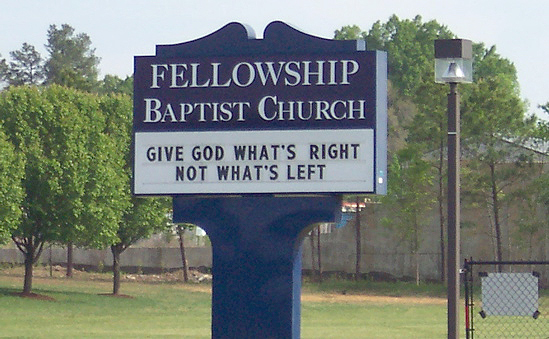
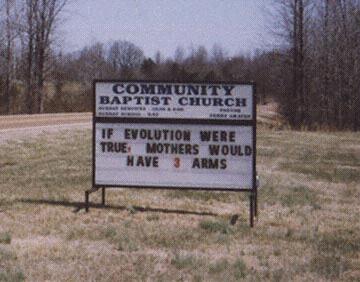
Slate.com has put together a slide show of the history of the church marquee. Beginning with ladies' needlepoint, church marquees thrived in the US where no state church means every religious idea must compete in the marketplace of souls. The medium has evolved into one of America's most visible forms of Bible bending.

Expanding on Slate's presentation, here are so more "only in America" marquees:


Friday, June 1, 2007

Battling presidential canidates, drugs and unions with the Bible; and more

Sun-Sentinel (FL): Florida evangelist Bill Keller says he was making a spiritual--not political--statement when he warned the 2.4 million subscribers to his Internet prayer ministry that "if you vote for Mitt Romney, you are voting for Satan!"

But the Washington-based advocacy group Americans United for the Separation of Church and State says the Internal Revenue Service (IRS) should revoke the 501 (c)(3) tax-exempt statue of Bill Keller Ministries, nonetheless.


Associate Press: Bobbleheads of Rev. Jerry Falwell holding a Bible are a big hit on ebay. An infamous Bible bender, Falwell will be remembered for statements such as this one, said shortly after 911: "I really believe that the pagans, and the abortionists, and the feminists, and the gays and the lesbians who are actively trying to make that an alternative lifestyle, the ACLU, People for the American Way—all of them who have tried to secularize America—I point the finger in their face and say 'you helped this happen." There is still time to purchase a piece of the man who said this and so much more.

The Guardian (UK): In the war against drugs that ravages Brazil, some preachers, armed with only a Bible, are willing to fight. Certainly there are worse weapons than telling someone that Jesus loves them, but I can think of better ones as well--off the top of my head, reforming a corrupt government that has failed to address the largest economic inequality in the world (according to the Gini coefficient) and educating the more than 15 million illiterate civilians come to mind. (Thanks to Simon for the tip.)

ABC (AUSTRALIA): An outspoken Australian union activist accused the political leadership of preferring to send workers to Bible study rather than negotiate wages. Western Australian Construction Forestry Mining Energy Union (CFMEU) secretary Kevin Reynolds has said Opposition Leader Kevin Rudd is out of touch with workers and wants them all to go to "bible class".

At the risk of revealing an ignorance of Australian politics, what does "wants them all to go to 'bible class'" mean? Does it mean that since workers are not going to get the wages they are demanding through negotiations, they have no choice but to pray for them instead? Is Reynolds suggesting that there is something in the Bible that they should explore in greater depth to help them resolve their differences? Is "bible class" a euphemism something? Or does this mean that in Australia, it is insulting to suggest that someone is somehow relying on the Bible? In any case, the deputy Labor leader, Julia Gillars, has said that her party will take these critical comments "on the chin."

New York Times (NY): In an editorial, US Senator and GOP presidential hopeful Sam Brownback clarifies his position on evolution. In the first presidential debate, Brownback was one of three candidates who raised their hand when asked, "is there anyone on stage who does not believe in evolution?" (YouTube clip here.)

Predictably, Brownback distinguishes between "creationism" (a literal interpretation of Genesis) and Intelligent Design (a more pliant Bible bending position that combines the biblical god with evolution). Brownback explains how he determines what "aspects of evolutionary theory" do and do not receive his approval: "Man was not an accident and reflects an image and likeness unique in the created order. Those aspects of evolutionary theory compatible with this truth are a welcome addition to human knowledge. Aspects of these theories that undermine this truth, however, should be firmly rejected as an atheistic theology posing as science."

Chicago Tribune (IL): Readers discuss whether the newspaper the usage of "Old Testament" in their articles with "Hebrew Testament."

Wednesday, May 30, 2007

A Bible Blog of Biblical Proportions!

Everyone has a fight to pick with Matt Drudge. He can create scandal out of thin air; he can make scandals disappear. He secretly controls the 2008 presidential elections. He is not a serious writer. Etc., etc., etc.

While his uncanny knack for digging up sensational stories and his pre-eminent access to breaking news secures his place on the desktops of news addicts around the world, his to-the-minute headlines could do without the constant references to the Bible. A reference to the apocalypse here, a mention of Noah's ark there, this is all part of the old-school tabloid feel, I understand. But Drudge takes a headline like "Naples's Trash is a challenge politicians are flunking" and turns it into: "Garbage crises of biblical proportions has gripped Naples, Italy."

But if you can not fight them, join them; and many newspaper editors have. So in honor of Drudge, here is a list of other headlines of "biblical proportions":
"Pomegranate ale holiday brew of biblical proportions"
"Developer, builders share their thoughts of biblical proportions"
"It was a bomb scare of biblical proportions"
"A crisis of biblical proportions"
"A gamble of Biblical proportions"
"Lamb--A History of Biblical proportions"
"Court debate of biblical proportions"
"Saints Predict a Miracle of Biblical Proportions"
"Family Dysfunction of Biblical Proportions"
"Conservatives condemn error of biblical portions"
"Souls cry out to God after a cataclysm of biblical proportions"

In brief, what we have here is an an ale festival, some real estate property, an environmental crisis, a film release, some lamb recipes, a Supreme Court hearing, a baseball come-back, a movie-marketing trend, gay marriage, and a tsunami of biblical proportions!

Negating the obvious question--what is a biblical portion?--I would like to answer an easier, though equally pressing one: should the word "biblical" be capitalized?

The grammatical answer: No, it is an adjective. The Bible Bending answer: trick question. Stop describing your festivals and disasters as "biblical."

Can you hear me Drudge?

Creation Museum Opens: the Biblical perspective inside, the Biblical rebuttal outside


The Creation Museum is now open for gawking. Tuesday afternoon Answers in Genesis opened its doors to 4,000 guests and dozens of protesters. Ken Ham, co-founder of the facility, told Christian Broadcasting Network that he wanted to build the museum "because dismissing the Genesis account as myth or allegory undermines faith in the rest of Scripture, including the Bible's teachings about sin, redemption, and marriage."

As guests attended the opening demonstrates who know the earth is billions of years old, jeered. One poster, Lawrence Krauss, a physicist at Cleveland's Case Western Reserve University who spoke with National Public Radio's Barbara Bradley Hagerty, summarized it this way, "It's important to speak out against nonsense."

But despite science overwhelmingly on the protesters' side, they pulled the Bible in with them. An airplane pulled a banner that read, "Thou shall not lie," proving once again that the Bible is the ideologues duct tape. Is there no view point that the Bible cannot hold together?

Sunday, May 27, 2007

Bible Bending Campaign Ad/Teenage Rebellion

Jordan Greene, the 15 year-old-son of the Georgia state congressional candidate Bill Greene, has posted a video of himself in a Bible study lead by his father. In the video, Bill reads a verse from Mathew 43: "I say unto you: love thy enemies..." at which point Jordan breaks out into The Right Brothers' (TRB) "The List."

For context, TRB is an underground punk band promoting a "rebellious" conservative message. They first drew wide public attention with the release of "Bush was Right" followed by other right-wing songs such as "The Enemy Within" ("blending in like they're one of us while inside their hatred for us rages; they made it do or die, so it's time for us to fight, it's time to fight the enemy within!"). As their website proudly proclaims, TRB contrasts the liberal message in mainstream music a "bold conservative message with loud guitars and no apologies!" They are pro-life, pro-U.S. troops, anti-Hollywood, and pro-Ann Coulter.

Jordan created this video as part of TRB's fan video project called "Liberals We Can't Stand." It might have been a delicious political talking-point if his father was running on the Democrat ticket. But given that Bill Greene is the founder and president of RightMarch.com (the conservative answer to MoveOn.com) where TRB received its first break, the video is not the typical act teenage of rebellion. Jordan even gives his father the last word as the music video fades back into the Bible study; Bill reminds his son: "Love your enemy for in so doing thou shall heap coals of fire upon his head." And with that final thought, Jordan looks rebelliously pleased with himself.

Watch it.